The Queer Wisdom Project: Building a Living Archive for Queer and Trans Individuals
Safe Access
Have you ever had a deeply frustrating conversation with anyone about cooking? You ask how much turmeric powder goes into a curry and they say, “just a pinch.” But what is a pinch? Is it a literal pinch? You eyeball it, sprinkle some in, and hope for the best.
Annoying as it is, the thing to notice is this: the knowledge still exists. It’s floating around, informal, embodied, passed around through gestures and half-sentences and muscle memory. You don’t need a manual. You just need someone to say, “this worked for me.”
Now, imagine growing up and beginning to realise that the feelings you are sitting with don’t seem to be shared by people around you. That attraction to your classmate of the same sex is not something you can voice when everyone is talking about their crushes, because you either do not understand what is happening, or you don’t feel safe telling other people. Or that one time a classmate calls you a lesbian to bully you, and while you vehemently deny it, something in you quietly pauses and wonders, “Am I a lesbian? Do I like girls? But guys are cute too. Whom do I like?!” What happens when you eventually accept your identity but none of the labels fit, Google is confusing, and every thinkpiece you read mentions different labels as core parts of queer identity?
This is where the cooking analogy breaks down, because for queerness, there is no one in the kitchen hovering nearby. No elder’s voice telling you how long to sit with a feeling, how to survive your first heartbreak, how to come out safely, or how to live a full life when the world keeps insisting you shouldn’t. Instead, we muddle through. We piece together scraps from Tumblr posts, Instagram carousels, whispered conversations, and late-night DMs that begin with “hey, can I ask you something personal?” Our help and advice come from our peers, fellow travellers in this world of pain, confusion, and joy.
And somehow, we’ve made it work.
That, at its core, is what Safe Access’s Queer Wisdom Project (QWP) is about. Taking all the learnings queer and trans people have accumulated, often painfully, often privately, and organising them. Making them tangible. Treating them not as whispers in the air, but as wisdom worth holding on to.
QWP is best understood as a living archive. Not an archive in the dusty, locked-away sense, but one that breathes, grows, and changes. Traditional archives tend to freeze knowledge in time, prioritising what is written, authorised, and institutionally sanctioned. Living archives, on the other hand, recognise that memory and knowledge are socially transmitted through stories, bodies, practices, and everyday survival. Scholarship on living archives and oral histories, particularly within marginalised communities, shows how these forms of knowledge resist erasure precisely because they are used, not just stored.
For queer and trans people in India, this matters deeply. Our access to knowledge has been repeatedly interrupted, either by criminalisation or by silence. What remains are whispered peer-to-peer transmissions; this helped me, this kept me safe, this made it hurt less. These teach you how to survive bullying in school, about building a home with a queer person, how to deal with being harassed in the streets, how to sit with and overcome heartbreak, how to navigate discrimination at work, and the joy of finding a community and building close connections. These are not universal truths. They are local, contextual, and deeply personal. And that is exactly their strength.
The Queer Wisdom Project does not ask for polished expertise. It doesn’t demand that experiences be generalisable or theoretically neat. It simply says: your lived experience counts. In spaces dominated by academic-led narratives, lived experience is often treated as anecdotal at best, unreliable at worst. QWP gently pushes back against that without turning it into an expert-versus-non-expert debate. Because the truth is simpler: we are all experts in our own lives. And sometimes the most useful knowledge is knowing how one person survived one specific thing.
There is a powerful idea, echoed in archival theory and community memory work, that bodies themselves are archives. Queer and trans bodies, especially, carry histories of adaptation, resistance, and care. We remember what worked because our bodies had to remember. When UNESCO says archives are a unique and irreplaceable heritage passed from one generation to another, it’s hard not to think about what happens when that heritage was never allowed to be openly passed down in the first place. Living archives like QWP attempt to bridge that gap; not perfectly, but intentionally. We have taken the idea of heritage as something to be passed down and changed it to something that works like a mesh of ideas. The knowledge that exists moves from peer to peer rather than a top-down approach.
Jacques Derrida once wrote, “What cannot be said above all must not be silenced but written.” Though rooted in discussions of censorship, the line feels painfully apt here. Being queer and/or trans in India often means being censored, whether it is through explicit violence or in small, cumulative ways; through silence, through omission, through the absence of language. Writing, sharing, and recording these experiences becomes an act of refusal. A way of saying: we were here, this happened, and this is how we survived.
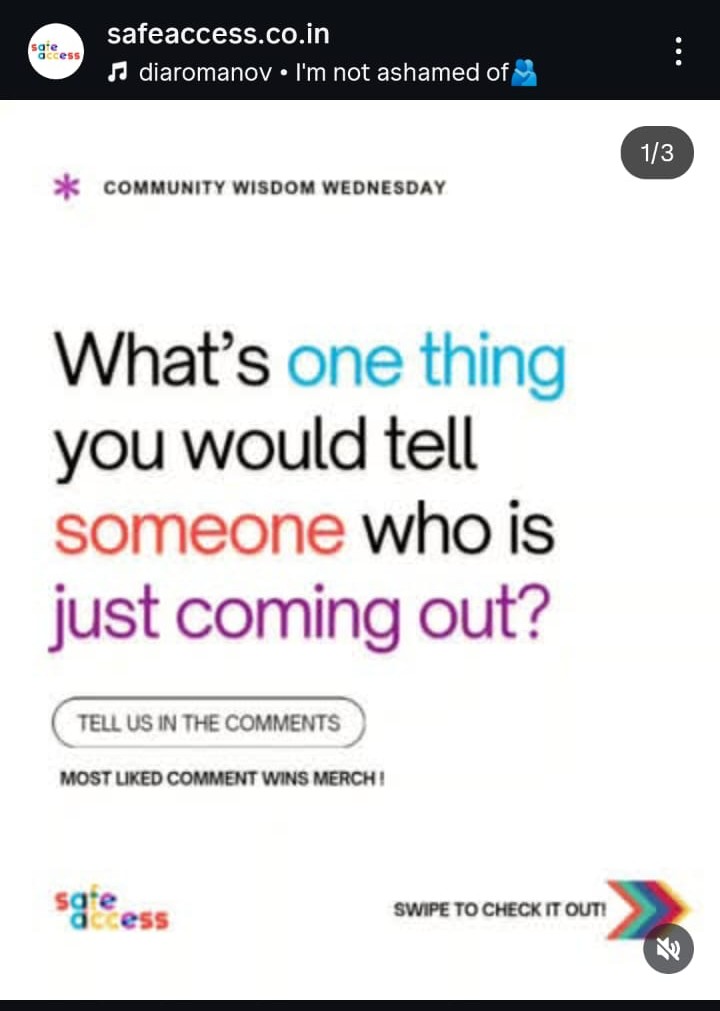
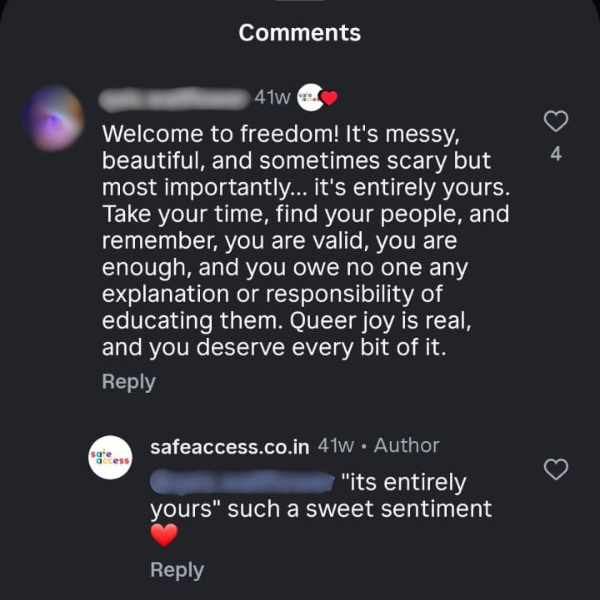
The Queer Wisdom Project does not claim to have answers for everyone. It does something quieter, and perhaps more radical: it creates a space where queer and trans people can speak to each other across time and place. Where someone can stumble upon a piece of wisdom and think, “Oh. I’m not the first person to feel this.” Where knowledge is not extracted, but offered.
Like cooking advice from someone, it may never come with precise measurements. But sometimes, knowing when to stop (such as not force-fitting yourself into someone else’s ideal) is wisdom in itself.
Note: We do not endorse or guarantee the accuracy, completeness, or usefulness of any information provided. Consult your healthcare provider before making any healthcare decisions or changes to your treatment based on information obtained from this platform. In case of a medical emergency or urgent situation, please seek immediate medical attention or contact your local emergency services.